Cybersecurity is no longer just a technical function buried inside IT. It is a board-level priority, a regulatory necessity, and a core component of business resilience.
Yet many organizations still approach security reactively — implementing tools, responding to audits, and addressing incidents as they arise.
The organizations that truly mature in cybersecurity do something different.
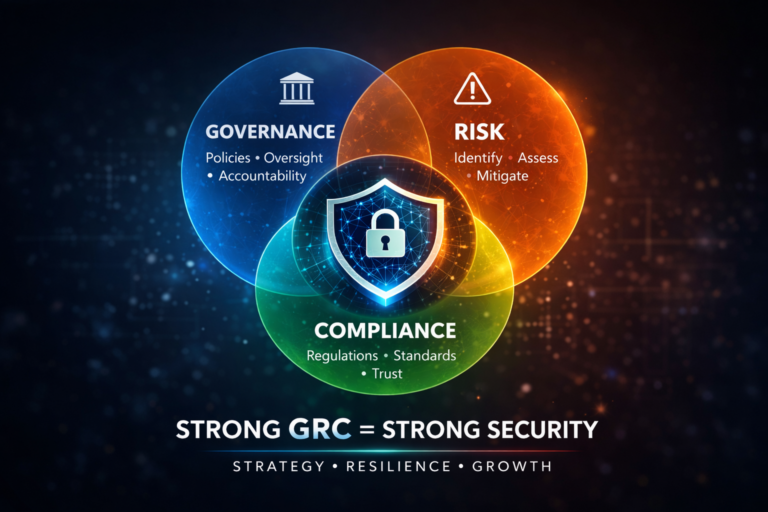
They build strong Governance, Risk, and Compliance (GRC) foundations.
Cybersecurity Without Governance Is Just Technology
Firewalls, SIEM platforms, endpoint detection tools — they are all important. But without governance, they operate in isolation.
Governance ensures that cybersecurity aligns with business objectives. It defines accountability. It establishes policies. It connects executive oversight to operational execution.
When governance is weak, security becomes fragmented.
When governance is strong, security becomes strategic.
Risk Management: The Bridge Between Security and Business
Cybersecurity is fundamentally about managing risk — not eliminating it.
A mature GRC program enables organizations to identify emerging threats, assess impact to operations and reputation, prioritize remediation based on business risk, and allocate resources intelligently.
This shift — from technical vulnerability management to enterprise risk management — is what elevates cybersecurity from a cost center to a business enabler.
Compliance Is No Longer Optional
Regulatory expectations continue to expand across industries. Frameworks such as ISO 27001, SOC 2, PCI DSS and HIPAA demand structured controls, documented processes, and executive accountability.
But compliance should not be treated as a checkbox exercise.
When integrated properly through GRC, compliance becomes a driver of operational discipline, a source of customer trust, a competitive differentiator, and a validation of security maturity.
Organizations that embed compliance into daily workflows — rather than scrambling before audits — significantly reduce exposure and reputational risk.
The Rise of Enterprise GRC
Many organizations start with siloed approaches — IT handles security, legal manages compliance, and risk teams operate independently.
This model does not scale.
Enterprise GRC centralizes documentation, reporting, and oversight. It provides leadership with unified visibility into risk posture across departments. It integrates third-party risk, regulatory obligations, and cybersecurity operations into a single strategic view.
In an era of complex supply chains, cloud adoption, and digital transformation, this unified perspective is no longer optional — it is essential.
Why GRC Matters More Than Ever
The threat landscape is accelerating. Regulators are intensifying scrutiny. Stakeholders expect transparency.
GRC provides:
Continuous compliance instead of point-in-time assessments
Risk visibility instead of reactive firefighting
Accountability instead of ambiguity
Resilience instead of fragility
Most importantly, it transforms cybersecurity from a defensive function into a strategic capability.
Final Thought
Technology alone does not secure organizations.
Structure does
Accountability does
Alignment does
Governance, Risk, and Compliance is not administrative overhead — it is the backbone of sustainable cybersecurity.
The organizations that recognize this are not just better protected. They are better positioned to grow, innovate, and lead.